
Introduction
Last year, we set out to determine which was the most durable pistol light. This year, I’m applying the same test procedure to defensive handheld lights, while also including more information regarding the performance of each.
This article is a companion to the video we have posted, providing you with all the performance data on these lights.
Disclosure
As per usual, I purchased all of these lights with my own money, and no portion of this review was paid for by any manufacturer. The tests are designed so that results are data-driven and not based on opinion.
That said, Werkz does resell some of these lights and get wholesale prices from their manufacturers.
Manufacturer Claims and Specs
For the test set, I selected (mostly) 18650-powered lights that are able to be carried every day. I say “mostly” because the Olight Warrior X4 and the Fenix P36R Pro are a little on the large side, and the Elzetta takes CR123A batteries. Regardless, every light selected was what seemed best, given the criteria, out of everything the manufacturer produces. Here are the lights, with their manufacturer’s claims and specs:
| Light | Lumens | Candela | Runtime (Minutes) | Battery Type | Manufacture Location |
|---|---|---|---|---|---|
| Cloud Defensive MCH-HC3 | 1,250 | 100,000 | 65 | 18650 | USA |
| Elzetta Bravo Model B552 | 600 | 15,750 | 90 | 2 x CR123A | USA |
| Fenix PD36R | 2,800 | 36,100 | 210 | 21700 | China |
| Malkoff MDC E2XTL | 800 | 55,000 | Unspecified | 18650 | USA |
| NiteCore EDC31 | 1,500 | 36,100 | 240 | 18650 | China |
| Noxon Evak T1 Core | 680 | 69,000 | 75 | 18650 | China + USA |
| Olight Warrior X4 | 2,600 | 99,225 | 163 | 21700 | China |
| Sig Sauer Foxtrot-EDC Fullsize | 1,350 | 33,000 | 90 | 18650 | China + USA |
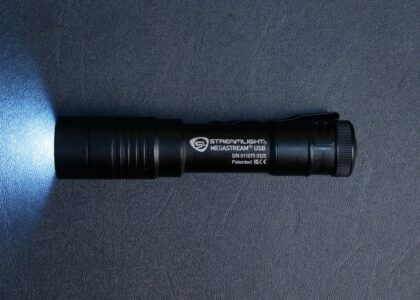
| Streamlight MegaStream | 1,800 | 26,000 | 120 | 18650 | China |
| EDC2-DFT Turbo | 700 | 100,000 | 165 | 18650 | USA |
| Light | Lumens | Candela | Runtime (Minutes) | Battery Type | Manufacture Location |
We’ve previously tested some of these lights, but I re-tested each sample in order to make sure the results are as fair and as representative as possible. I purchased three of each, meaning I measured data from a total of 30 lights, in three discreet tests. Even though I shopped on Black Friday, the total came out to around $4,400 worth of lights. UPDATE: Cloud Defensive was unable to deliver lights in time for testing, so I tested two unused samples I had previously purchased a year or longer ago.
First Items
Price
Affordability is an important factor. I graded lights with the least expensive light getting a score of 5, and the most expensive a 1. Here are street prices as of January 2026:

Here are the first round scores:

Availability
While we live in a world where everything seems to be instantly available, not all lights are. Some lights have be ordered only from the manufacturer, some can be had in a day or two from Amazon, and some lights could be purchased at the corner store. Well… none of these lights are purchased at the corner store, but you get the idea. Higher scoring lights are more available, and if a light is unavailable within a reasonable time (as the Cloud Defensive lights were), then the light gets a low score.

Features
My minimum feature set for a handheld defensive light is a tailcap switch that gives “high” mode when I hit it. All of these lights meet that criteria. Additional features I appreciate include an additional “admin” mode that provides less light output, USB-c charging, in-light charging, inclusion of extra batteries, multiple programmable modes, pocket clips, and more. Here is my grading on these lights feature set.

User Interface
A light must be easy to operate, especially under stress. Defensive handheld lights need an easy and repeatable way to activate high mode momentary and constant. If I try to turn on a light’s constant mode, and it only activates momentary, then I’ll be without light when I critically need it. If a light gives me strobe mode unexpectedly, then that is bad. In this case, the Olight Warrior X is extremely difficult to turn on in constant mode, instead favoring momentary. The “gate” is finicky, which means that if you time how long or deep you press the button, then the light stays on, but if you don’t then you’re out of light. It gets the lowest score on this metric.

Form Factor
If a light is too big or bulky, I’m not likely to carry it. Smaller lights that still fit well in my hand are preferred. I graded the lights on form factor, with the largest light getting a 1, and the smallest getting a 5.

Into the Lab: Candela, Lumens, Runtime, Color Temperature and CRI
Candela
A light’s candela measurement represents its ability to “throw” light – that is, illuminate objects at distance, and punch through photonic barriers like tinted windows. Because of the way beams are focused, a light with high lumen output may not necessarily provide high candela, and vice-versa.
Here are all of the candela measurements, for each sample of light:
The above chart is sorted alphabetically.
The SureFire EDC2-DFT produced the most candela by far, even more than the much larger Warrior X4. That said, these two lights have very different beam profiles, with the Olight producing a wider beam, and the Surefire much more focused.
Here is my ranking which is done by averaging the 3 samples and ranking the lights by output at 30 seconds. You can see the Surefire far exceeded it’s 100,000 candela claim, and other lights didn’t meet their claims:

Which results in the following scores:

Lumens
Lumens are a raw measurement of the output of a light. Here is the entirety of the data I measured from all twenty-nine samples I had:
Here’s a closer look at the first ten minutes:
Here is the ranking of the average 30 second lumen results. Note that the Fenix has the highest initial output, but I’m choosing to measure at 30 second to reduce the chance a manufacturer is gaming the numbers:

The highest output light at 30 seconds get a 5, and the lowest a 1:

Runtime
Rather than using the ANSI/PLATO standard for runtime, which is based upon a light’s specifications, I simply ranked the light output at 2 hours. I’ll seldom need a handheld to last 2 hours, but if I do, I’m guessing it’s for a good reason, and I want the most light I can get.
Here is the ranking:

And it results in these scores:

Color Temperature and CRI
Color temperature and CRI are both measurements of light “quality,” which impact positive identification. A light with a very high (or very “cool”) color temperature, coupled with a low CRI, will make targets more difficult to positively identify. Because of the scale of the data, the information will be presented with a simplified table. If you’re interested in the full data, click here.
In general, a color temperature around 5000K is ideal, and higher CRI is better. “R9” represents a certain band of light responsible for rendering the reds in a subject, which are particularly challenging for LEDs to produce.
Here’s another way of presenting the data, with a heatmap-style chart:
Out of all these lights, the Elzetta had by far the best color temperature, CRI, and R9 value. The Streamlight MegaStream had the lowest CRI of the group, and the worst R9 value. The worst color temperature was sample one of the Noxon Evak T1 Core, at 7553K, followed by two samples of the Olight Warrior X4 at 7304K and 7160K.
2026 Handheld Lights Color Temperature and Rendering Index
I ranked the light based upon the data with the best light quality getting a 5, and the worst a 1 as follows:

Unit Consistency
I’ve tested hundreds of lights. Some manufacturers produce extremely consistent lights. Other manufacturers don’t do as as good a job, and you could get a great one or you could get a dud. Based upon samples on hand, I compared how consistent their output is and ranked them. A lower rank means that the tested samples were inconsistent, meaning it is more likely customers in the field are getting varying output, and vice-versa. The Streamlight samples were extremely consistent, while the Cloud Defensive were the least.


Here is the score for this test using similar calculations for all lights:

The scores right up until durability testing highlight the Nightcore, Streamlight, and Fenix as taking an early lead. However, there is still durability testing…
Durability Testing
Introduction
Each light has three “lives” to use over the course of my durability testing. Each test can earn a light up to five points, for a total of fifty points in the durability category. The three best performers graduate to my final test, which is more extreme than anything a tactical handheld should ever have to endure!
Vibration
My vibration test is a gentle introduction to my gradually intensifying set of tests. If a light can’t handle a little bit of vibration, it certainly isn’t suitable for tactical/edc.
Every light is loaded into the test fixture and run for 90 minutes.
After returning, I find all lights in good working order, with no issues.
Each light gets 5 points for this test.
Mist
Even a light that isn’t technically waterproof should be able to handle environmental moisture. All ten of these lights are waterproof-rated, to at least IPX-7.
| Light | Waterproof Rating |
| Cloud Defensive MCH-HC3 | IPX-8 |
| EDC2-DFT Turbo | IPX-7 |
| Elzetta Bravo Model B552 | ?* |
| Fenix PD36R | IP68 |
| Malkoff MDC E2XTL | ?* |
| NiteCore EDC31 | IP68 |
| Noxon Evak T1 Core | ?* |
| Olight Warrior X4 | IPX8 |
| Sig Sauer Foxtrot-EDC Fullsize | IPX7 |
| Streamlight MegaStream | IPX7 |
*I couldn’t find the waterproof ratings for some of these, but given their o-ring sealed construction they seem like they should be waterproof.
My mist test exposes whether the light has any glaring flaws when it comes to environmental resistance.
I load all ten lights up into the mist tester, and ran it for 45 minutes.
When I returned, all lights are still running perfectly.
Each light gets 5 points for this test.
Rest of Durability Testing
For the rest of the durability testing, please watch the video. It’s a much better illustration of the lights, damage, and analysis.
Winners
Here are the ranks after all the testing is complete:

Based upon the test results, I can say the following 3 lights are clear winners.
#1: Streamlight Megastream
This is a high quality light at a reasonable price, and extremely durable.
#2: Surefire EDC2-DFT Turbo
I carried(*) this light for quite some time, and I can vouch that it is the candela king. If I need to see across my property at night, this is the light to do it with. As the tests have shown, it is another quality light with great build quality, but it is also the most expensive of the bunch.
(* I currently carry a Surefire Stiletto Pro II because I like the form factor and admin modes.)
#3: Fenix PD36R Pro
Even though this light has huge output and runtime owing to its larger 21700 battery, it’s just a tiny big bigger than the Streamlight and Surefire. It also has a large feature set at a reasonable price.